A major new report from Grains Australia lays bare the significant economic impact of non-tariff measures (NTMs) on Australian grain exports, revealing billions of dollars in lost revenue for the industry.
The analysis provides the most comprehensive assessment to date of how NTMs affect Australian grain exports, and identifies opportunities for targeted reform to strengthen the long-term competitiveness of the industry.
The report reveals that existing NTMs are equivalent to a tariff of 20.4% on Australian grains, around four times higher than the average tariff applied by Australia’s top ten grain-importing destinations. These NTMs result in an estimated $4.6 billion in forgone export revenue each year.
This analysis builds on foundational research completed by ABARES in March 2025 (Non-tariff barriers: A multi-billion dollar burden) and utilises world-leading economic methodologies in collaboration with researchers from the Australian National University (ANU).
Grains Australia CEO Richard Simonaitis said addressing the challenge of NTMs was increasingly urgent.
“Market access is increasingly shaped by regulatory and technical requirements rather than tariffs”, he said.
“As traditional trade barriers fall, new and often complex regulatory hurdles are taking their place, creating increased risk and uncertainty for Australian exporters.
“This is an inherently complex problem. The goal is to distinguish between strategic rules that reward the safety and quality of Australian grain, and inefficient measures that add cost without delivering value.”
The report highlights potential strategic actions the industry could consider, including:
- Prioritising reductions in inefficient, costly, duplicative NTMs through targeted technical and government engagement.
- Strengthening international negotiations through market-specific strategies.
- Involving industry at the table.
- Driving domestic reform to bolster sector resilience.
“Effective engagement with trading partners regarding NTMs requires not only sustained effort and skilled diplomacy, but also robust, credible and compelling evidence,” Mr Simonaitis said.
“To negotiate effectively, the Australian industry needs a clear and detailed understanding of the NTM landscape.
“This report equips the Australian grains industry with the insights and data needed to address the issue of NTMs.”
ENDS
Media enquiries: Keir.Tunbridge@grainsaustralia.com.au
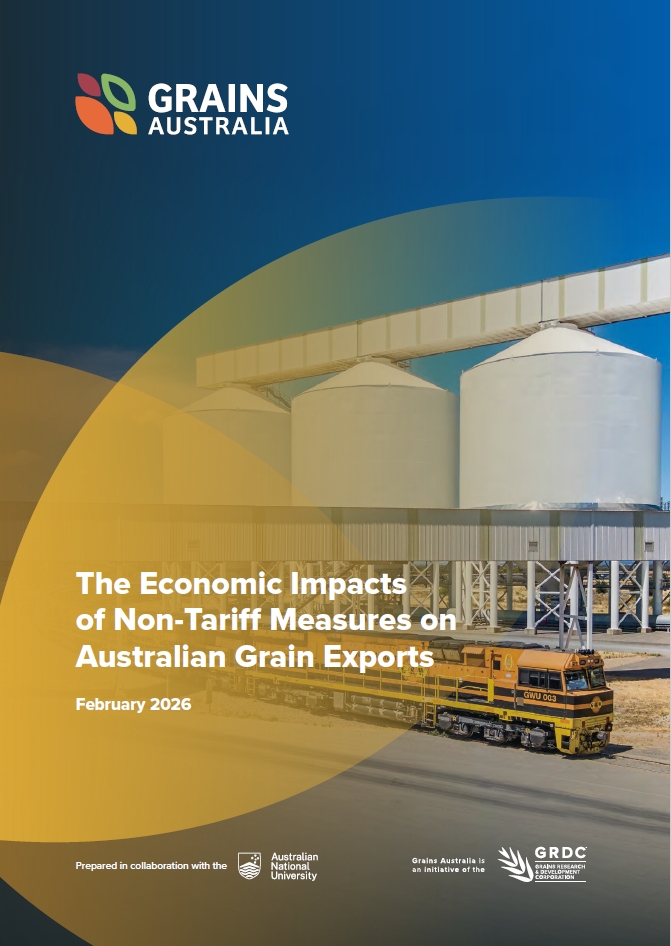
Grains Australia report: “The Economic Impacts of Non-Tariff Measures on Australian Grain Exports”
This report was prepared by a team of agricultural economists, econometricians and trade specialists from the Australian National University (ANU), James Cook University and international partner institutions, led by Professor Yu Sheng (ANU). The team combines deep expertise in agricultural production, international trade, productivity analysis and general equilibrium modelling, with experience spanning academia, government agencies such as ABARES, and global research organisations.
Grains Australia also acknowledges the previous analysis completed by ABARES.
About Grains Australia
A stronger, more competitive grains industry
Grains Australia delivers key functions critical to the success of the Australian grains industry.
- Trade and market access
- Classification
- Market insights
- Market education
- Technical market solutions
Grains Australia leads a Team Australia approach, collaborating across the grains value chain to prioritise initiatives that deliver maximum value for growers, industry and customers.
In order to better support the Australian grains industry and its customers, the functions formerly delivered by the Australian Export Grains Innovation Centre (AEGIC) are now part of Grains Australia.
Grains Australia is an initiative of the Grains Research and Development Corporation (GRDC). GRDC leads investment in grains research, development and extension (RD&E) in Australia to create enduring profitability for grain growers.
February 15, 2026