Noodle lovers in Japan know exactly what they want when it comes to udon. The perfect udon noodles should have a mouthfeel known as ‘mochi mochi’ – a unique balance of softness and firmness, combined with good elasticity and a slight stickiness. Appearance is also crucial; udon noodles must have a bright and creamy very slightly yellow colour, with good colour stability – i.e. they stay looking good for longer. Japanese flour millers know that the best wheat for udon is grown in Western Australia.
For more than 35 years, Japan has exclusively imported noodle wheat from WA that has been bred especially for udon. WA supplies about 750,000t of a special noodle wheat blend to Japan at a value of around $300 million annually.
Grains Australia, Australia’s market-facing agency for the Japanese noodle market, supports this market through sensory assessment of new breeding lines, as well as providing technical support and resources to address seasonal issues. Korea is the only other market that currently imports noodle wheat from WA.
The Japanese noodle wheat market is uniquely stable in both volume and value. The ongoing success of the relationship between WA and Japan is mutually beneficial and each partner is prepared to invest resources to ensure its success.
The entire supply chain, from the farmer in WA to the consumer in Japan, benefits from this investment.
Grains Australia works closely with the Grain Industry Association of WA (GIWA), CBH Group, and breeding companies like InterGrain and Australian Grain Technologies (AGT) to make sure this unique partnership between Japan and Australia thrives. This relationship was previously managed by AEGIC.
Grains Australia is Australia’s market-facing agency for the Japanese noodle market.
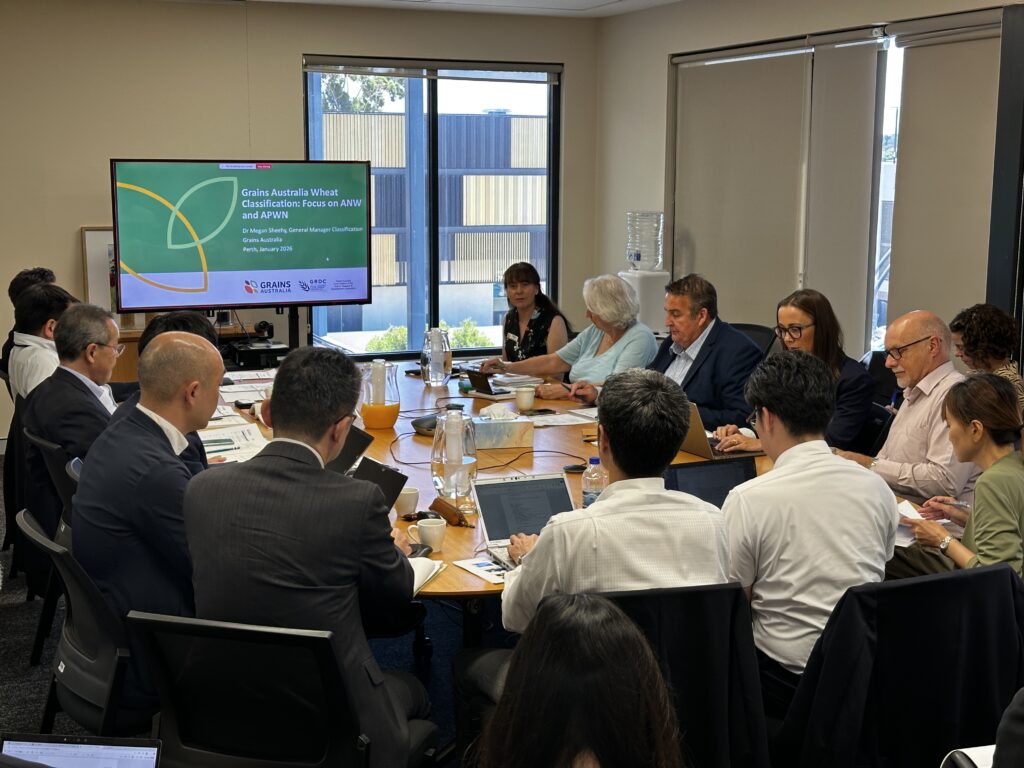
In January 2026, Grains Australia welcomed a delegation from the Japan Flour Millers Association (JFMA) and Japan’s Ministry of Agriculture, Forestry and Fisheries (MAFF), reinforcing the long-standing, mutually beneficial relationship between Australia and Japan’s udon noodle industry.
Each year, representatives from MAFF and JFMA travel to Western Australia to receive up-to-date insights on the quality and supply of that year’s udon wheat crop. These regular meetings are a key fixture in our shared calendars, providing critical industry updates and the opportunity to discuss seasonal conditions and industry issues.
Discussions included the supply and quality of the most recent harvest, updates on upcoming noodle wheat varieties, and agreement was reached on the noodle wheat blend ratio for 2026.
The meeting was positive with both sides reaffirming ongoing commitment to the strong, mutually beneficial relationship between WA and Japan’s udon wheat industries.
The meeting was hosted by Grains Australia, GIWA’s Wheat Council and CBH Group, with participation from breeding companies InterGrain and AGT. Continual relationship building and technical collaboration remain central to the strength and success of the WA-Japan udon noodle relationship.
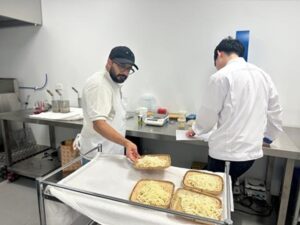
In February 2026, Grains Australia hosted a visiting noodle expert representing the Japan Flour Millers Association (JFMA) to assess potential unreleased udon noodle wheat varieties.
For three weeks, the visiting expert worked with us to assess a series of batches of udon noodle wheat from Australia’s major wheat breeding companies.
Sensory evaluation is a crucial aspect of making sure Australian udon noodle wheat meets the needs of Japanese customers.
Watch this ABC Landline story to find out how Grains Australia supports wheat growers in Western Australia to supply udon noodles across Japan and to become one of Australia’s success stories in premium grain exports.
The story is also featured in ABC Radio National’s “Every Bite” program.
Sensory collaboration with Japan Flour Millers Association 2026
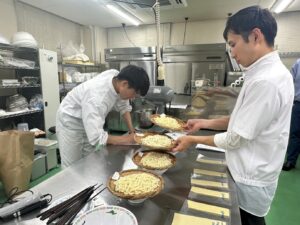 Joint sensory evaluation sessions with the Japan Flour Millers Association Technical Committee in Tokyo in June 2026 gave customers the opportunity to assess the quality and performance of several newly classified Australian Noodle Wheat (ANW) and Australian Premium White Noodle (APWN) wheat varieties.
Featured on this year’s menu were new ANW varieties from Australian Grain Technologies, along with InterGrain’s new APWN variety.
There is no better way for Australian breeding companies to understand market quality preferences and variety acceptability than hearing directly from customers. The sessions provided valuable feedback and insights to help guide future breeding programs and inform classification decisions.
Background and history of the noodle wheat segregation
- Grains Australia runs the official noodle sensory evaluation program on behalf of the Australian industry.
- During the late 1970s and 1980s, Japan realised that wheat from Western Australia was excellent for traditional Japanese udon noodles, which have unique and strict quality requirements.
- This was due to a wheat variety called “Gamenya”.
- Gamenya became popular with Western Australian growers in the mid-1960s following a devastating epidemic of stem rust. Gamenya had the best rust resistance at the time and was well-suited to WA.
- Gamenya was a leading variety for 20 years until the mid-1980s, when growers began planting higher-yielding varieties. Gamenya production dropped drastically.
- By this time, Japan had come to rely on Western Australian shipments of the wheat class “Australian Standard White” (ASW) to make udon noodles.
- The reduced amount of Gamenya in ASW exports from Western Australia meant lower quality noodles in Japan.
- At the same time, a new variety “Eradu” was released with similar qualities to Gamenya.
- In March 1989, at a wheat industry seminar, Dr Graham Crosbie, a cereal chemist with the WA Department of Agriculture, publicly called for a brand-new noodle wheat segregation to be immediately established.
- This would go down in history as the spark which led to the noodle wheat segregation.
- The new segregation would concentrate the dwindling supplies of the key noodle wheat varieties to ensure shipments to Japan contained the right types of wheat for udon.
- Importantly, the segregation would return guaranteed price premiums to growers to support their profitability and encourage the production of noodle wheat.
- While controversial at the time, this ultimately proved to be highly successful. Noodle wheat production increased, value was increased for growers, and Japan had their udon noodles.
- The ongoing success of this special relationship between WA and Japan is down to the fact that it is mutually beneficial and each partner is prepared to invest resources to ensure its success.
- Western Australia continues to invest in new, improved noodle wheat varieties. Japan regularly sends visiting experts to help assess unreleased varieties.
- On behalf of the WA noodle wheat industry, Grains Australia, and the GIWA Wheat Council (Grain Industry Association of WA) leads the relationship with Japan and provides technical support, crop reports, and resources to address any seasonal issues that arise.
- AEGIC ran the noodle sensory evaluation program from 2013 to 2025, after taking over from the old Department of Agriculture and Food Western Australia (now DPIRD).
- From 1 January 2026, the udon sensory evaluation program continues under Grains Australia.
Grains Australia is an initiative of the Grains Research and Development Corporation.